







Designing or remodeling a hotel, restaurant or commercial space is an exciting job. Everyone wants their project to look premium. We want it to feel welcoming. We want people to carry a strong impression every time they walk in. But when it comes to choosing materials, things can get complicated pretty quickly.
A countertop may look beautiful in photos, but there are several questions that need to be answered. Can it handle heat and spills? Is it fit for heavy daily usage? Which material can sustain constant cleaning in a busy commercial environment?
That is where marble countertops come out as the top choice. But again they also come with their shortfalls. That is why understanding how marble performs in real commercial applications is very important. In this marble countertops guide, we will learn about heat resistance, design basics, types of marbles and different facets of commercial applications.
Understanding Marble Countertops
What Marble Is and How It Is Made
Marble is a natural stone. It is formed deep inside the earth after curating for millions of years. It starts as limestone. Over time, through a natural geological process, the intense heat and pressure transforms the limestone into marble.
This process creates the veining and moving pattern that marble is known for. It is unique and exclusive in every marble piece.
No two marble slabs are exactly alike. This is one of the biggest reasons designers and architects prefer marble for luxury interiors. It gives spaces a more natural and custom appearance compared to many engineered materials.
Marble comes in many colors and patterns. World over white marble remains one of the most popular choices. However, gray, black, green, beige and dramatic veined marble designs are also commonly used in modern commercial interiors.
Common Marble Surface Finishes
The appearance and performance of marble countertops depends on the finish.
Polished Marble Countertops
Polished marble has a glossy and reflective surface. This finish makes the veining stand out more clearly. It gives the countertop a luxurious appearance.
Polished marble is commonly used in:
- Hotel vanity tops
- Luxury reception counters
- Decorative feature islands
- Retail display counters
- Boutique hospitality interiors
However, polished marble can show scratches and etching more easily over time. This happens more commonly in areas of heavy commercial usage.
Honed Marble Countertops
You must now be thinking what is honed marble. It is a marble that has a softer matte finish and not glossy.
This type of marble is popular in commercial projects because it hides the scratches and fingerprints. It bears the wear and tear better. It creates a more relaxed and modern outlook while being easier to maintain in busy spaces.
Marble Countertops vs Quartz and Solid Surface
When selecting materials for commercial interiors, the competition lies between marble and its rivals. The quartz countertops and solid surface countertops.
Below you can scan through a quick comparison. It will help you understand the features of each better.
| Feature | Marble Countertops | Quartz Countertops | Solid Surface Countertops |
| Appearance | Natural stone with unique veining and movement | Engineered artificially with more consistent colors and patterns | Smooth and modern appearance |
| Design Style | Luxury, classic and high-end visually | Clean, uniform and contemporary looking | Minimalist and functional commercial design |
| Heat Resistance | Handles moderate heat but can be damaged by thermal shock | Moderate heat resistance but resin can be affected by high heat | Moderate heat tolerance but should avoid direct hot cookware |
| Maintenance | Requires sealing and careful cleaning | Lower maintenance and non-porous | Easy to clean and maintain |
| Repairability | Repairs can be difficult and visible | Harder to repair if chipped | Easier to repair and refinish |
| Seamless Joints | Visible seams depending on slab size | Visible seams | Seamless fabrication possible |
| Hygiene | Porous if unsealed | Non-porous | Non-porous and highly hygienic |
| Best Commercial Uses | Hotel lobbies, vanity tops, luxury retail, decorative counters | Office kitchens, residential projects, moderate-use spaces | Healthcare, hospitality, restaurants, commercial workspaces |
| Main Advantage | Premium natural beauty and visual impact | Consistency and easier maintenance | Durability, hygiene, and seamless integration |
| Main Limitation | Can stain, etch, and require more maintenance | Less natural appearance compared to marble | Less natural stone character and luxury veining |
Key Properties of Marble Countertops
Marble Is a Porous Natural Substance
You should know that marble is porous by nature. This means that if they are not sealed properly the surface of marble countertops can absorb liquids.
In commercial settings, different liquids are in use. Sometimes the coffee, wine, oil, lemon juice, sauces, shampoos, makeup and even acidic cleaning chemicals can cause staining or etching on the surface.
For this reason you need to have proper sealing done. It reduces the above mentioned risks. Most commercial marble countertops need periodic resealing to maintain their appearance and improve stain resistance.
Natural Cool Marble
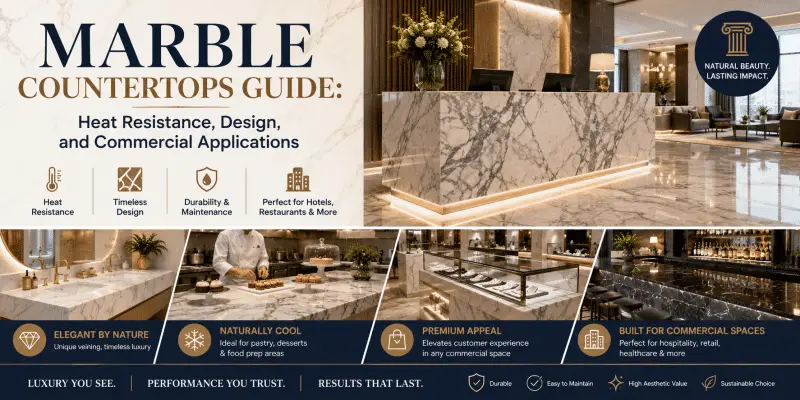
Very often we see that pastry chefs and bakers prefer to have marble countertops in their commercial kitchen. This is because marble stays naturally cool.
Marble absorbs heat quickly. It keeps a lower surface temperature for longer periods. This makes it useful for pastry preparation, dessert stations, bakery counters and chocolate work areas.
Longevity in Commercial Environments
Marble is a longlasting material. But it requires proper maintenance.
You can still find marble surfaces in historic hotels, luxury buildings and commercial interiors that are many years old. But long-term performance heavily depends on where and how the marble is used.
Marble performs best in:
- Reception counters
- Hotel bathroom vanity tops
- Retail display counters
- Decorative commercial surfaces
- Luxury hospitality interiors
- Low-impact kitchen areas
It is less ideal for extremely heavy-duty prep zones where direct heat, sharp impacts, or harsh chemicals are common.
Is Marble Heat Resistant?
The short answer is yes. Marble is a heat resistant countertop, but to a certain point. Marble is not completely heat proof.
Marble being natural stone is thought to handle unlimited heat. People think that because it is formed under heat and pressure it can tolerate moderate heat better than some engineered materials. Yes it can. But it can still become damaged under sudden or extreme temperature changes.
Marble is Suitable for Moderate Heat
In normal day-to-day use, marble countertops usually handle moderate heat without immediate damage.
For example:
- Hot coffee mugs
- Warm dinner plates
- Small cookware
- Hair styling tools in bathrooms
- Heated serving dishes
These items usually do not create major problems when exposure is short term.
Thermal Shock Risk in Marble Countertops
The bigger concern with marble is thermal shock.
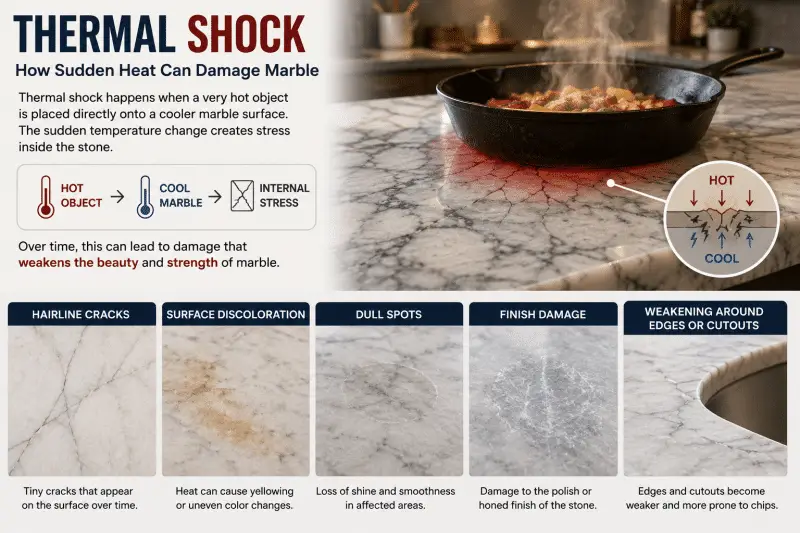
Thermal shock happens when a very hot object is placed directly onto a cooler marble surface. The sudden temperature change creates stress inside the stone.
Over time, this can lead to:
- Hairline cracks
- Surface discoloration
- Dull spots
- Finish damage
- Weakening around edges or cutouts
This is why when you place a cast iron pan straight from the oven onto marble, it can be risky. Even high-quality marble can become damage from repeated thermal shock.
Can Marble Countertops Burn?
Marble does not burn itself. However by excessive heat, the finish and sealers on the surface can become damaged.
Very hot cookware may leave:
- Yellowing
- Burn-like marks
- Dull patches
- Surface etching
- Discoloration
This becomes too visible on white marble countertops with polished finishes.
How to Protect Marble Countertops From Heat Damage
You can protect marble countertops by using a few basic habits. They can help preserve the surface for many years.
Usage of Trivets and Heat Pads
Under hot cookware commercial kitchens, hotels and homeowners should always use trivets or heat pads. This small step can very much reduce the risk of thermal shock.
Proper Sealing Maintenance
Sealers help in protection of marble from moisture and stains. A properly sealed surface also performs better over time in areas exposed to occasional heat.
Avoid Sudden Temperature Changes
Rapid temperature changes are harsher for marble. They are worse than gradual warmth.
For example, placing a freezing cold item next to an extremely hot pan can stress the stone surface.
Commercial Applications for Marble Countertops
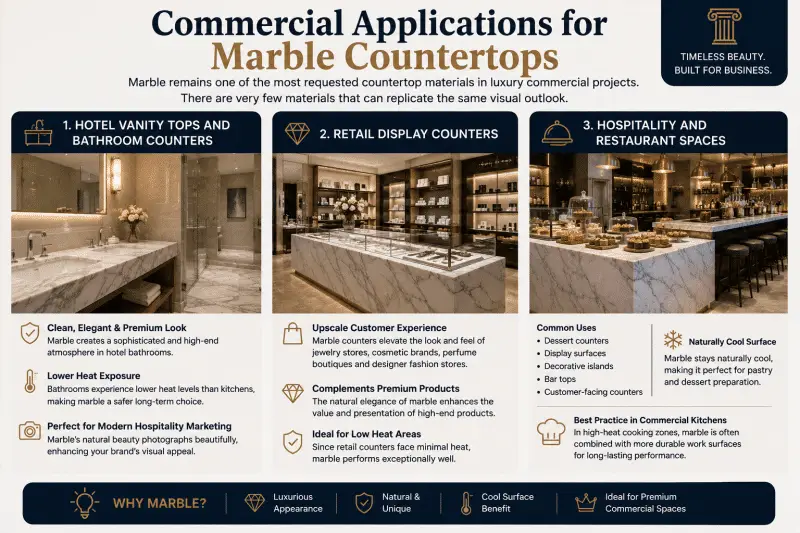
Marble remains one of the most requested countertop materials in luxury commercial projects. The reason is simple. There are very few materials that can replicate the same visual outlook.
Hotel Vanity Tops and Bathroom Counters
Luxury hotels mostly utilize marble vanity tops in their bathrooms. These can create a clean, elegant and premium outlook. Marble is exposed to lower heat levels in hotel bathrooms as compared to kitchens. This is why it is a safer long-term application.
Marble also photographs beautifully. This matters a lot in modern hospitality marketing.
Retail Display Counters
Luxury retail stores and branded outlets often employ marble counters. This creates a more upscale customer experience. Marble surfaces are very commonly installed in jewelry stores, cosmetic brands, perfume boutiques and designer fashion stores. It helps complement the products for more premium feel.
Since retail counters usually experience minimal heat exposure, marble performs very well in these environments.
Hospitality and Restaurant Spaces
Restaurants, bars, cafés, and hospitality spaces often use marble for:
- Dessert counters
- Display surfaces
- Decorative islands
- Bar tops
- Customer-facing counters
The cool surface temperature makes marble especially popular for pastry and dessert preparation.
However, in active commercial kitchens, marble is usually combined with more durable work surfaces for high-heat cooking zones.
Advantages of Marble Countertops in Commercial Projects
Luxurious, Classic Appearance
This is one of the biggest strengths of marble countertops. The overall visual appeal. Marble very quickly makes a space feel high end. Even simple interiors can look more upscale when marble is added.
Unique Natural Veining
Marble is natural stone. Every slab looks different. This uniqueness gives commercial projects a more custom and high-end outlook. Architects and interior designers often use marble as a statement material. This is because it creates visual movement and texture naturally.
Natural Cooling Surface
Marble countertops stay naturally cool. This makes them useful for pastry, dough and dessert preparation. This is one reason marble is very common in bakeries, cafés and hospitality kitchens.
Longevity with Proper Care
Well-maintained marble is very durable and lasting. Marble is popular across generations because it can be maintained for years.
Limitations of Marble Countertops
Marble Requires Maintenance
Marble is beautiful. But it is not maintenance free. Commercial property owners need to understand this. Marble requires:
- Periodic sealing
- Careful cleaning
- Immediate spill cleanup
- Heat protection
- Professional restoration if damaged
All this still does not make marble a bad material. It simply means marble works best when used in the right environment.
Acidic Spills Cause Etching
Marble can become dull over time with acidic liquids like lemon juice, vinegar, wine and certain cleaning chemicals. This is called etching. Etching is more visible on polished marble surfaces.
Higher Material and Installation Costs
Marble is considered a premium material. The cost of premium slabs, transportation, fabrication, sealing and professional installation can be higher compared to many other countertop options.
For large commercial projects, maintenance planning should also be part of the budget discussion.
KKR Solid Surface Countertops: A Practical Marble Alternative
Solid Surface Countertops as an Alternative to Marble
Marble countertops remain a popular choice for luxury commercial interiors. However, you cannot use them as the best fit for every project. Hence, clients who are seeking a more budget friendly and lower maintenance solution for countertops, solid surface countertops is also a popular marble alternative.
As discussed, marble delivers unmatched natural beauty and distinctive veining. This makes it ideal for high-end reception areas, hotel vanity tops, luxury retail counters and decorative feature spaces.
However, marble requires regular sealing. It can easily be susceptible to staining and etching. Using marble also means having higher installation and maintenance costs.
As an alternative to marble, the solid surface countertops offer a different set of advantages. They provide a non-porous surface. These are easier to maintain, require seamless fabrication and are excellent in hygiene performance. These qualities make them particularly suitable for healthcare facilities, restaurants, commercial kitchens, educational facilities and other high-traffic environments where practicality is a priority.
For example:
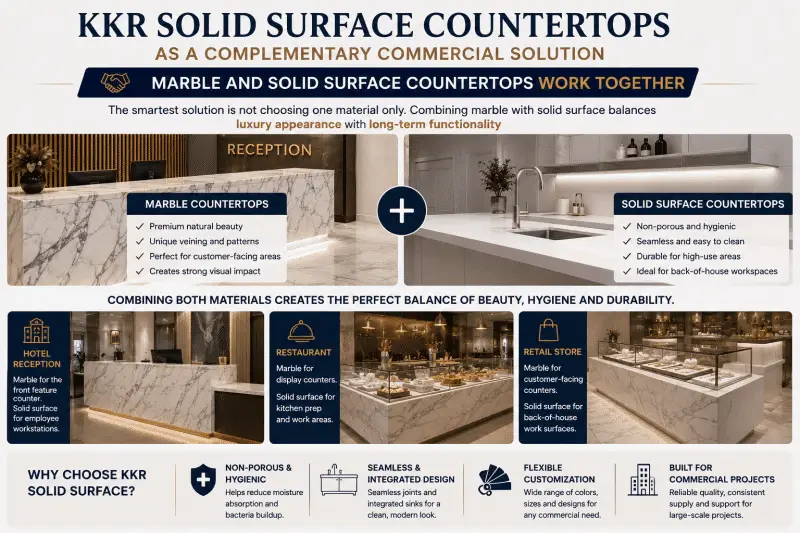
- Hotels seeking a luxury outlook may choose marble for premium guest-facing areas. For projects with tighter budgets they may opt for solid surface countertops as the best marble alternative throughout the property.
- Restaurants reqire easy cleaning and sanitation. Hence, they may prefer solid surface countertops over marble for food preparation and service areas.
- Commercial offices and healthcare facilities often select solid surface material. This is because of their seamless appearance and low maintenance requirements.
Ultimately, the right choice depends on the project’s design goals. It also relies your maintenance expectations, allocated budget and intended application.
Marble offers timeless luxury and natural character. At the same time, the solid surface countertops provide durability, hygiene and cost-effective performance for demanding commercial environments.
Marble vs Solid Surface Countertops: Quick Comparison
Selecting the right countertop material depends on your project needs, the budget and your desired level for maintenance. Here’s a clear comparison of marble and solid surface countertops for commercial applications:
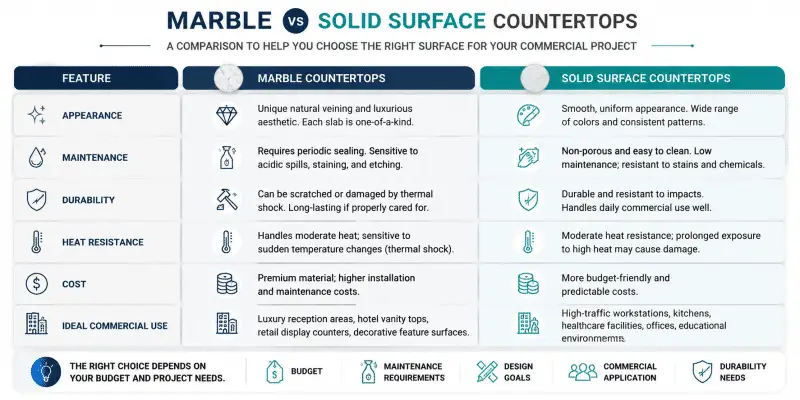
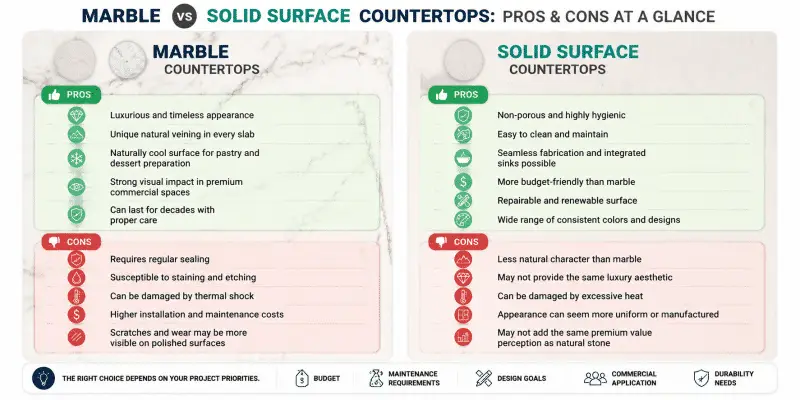
For more guidance, here is a snapshot of the pros and cons of both the materials.
Reasons Why KKR Solid Surface Countertops Are the Best Marble Alternative
For commercial projects requiring better hygiene, flawless fabrication and easier maintenance, KKR solid surface countertops offer several advantages.
Non-Porous and Hygienic Performance
The solid surface countertops by KKR are non-porous. Hence they are different from marble. This helps reduce moisture absorption. It makes the surface cleaning easier.
Fabrication without Seams and Integrated Design
Solid surface materials can be fabricated with seamless joints and integrated sinks. This creates a cleaner appearance. It also reduces dirt and bacteria buildup around seams.
Flexible Customization for Commercial Projects
Large commercial projects often require:
- custom sizes,
- color consistency,
- integrated fabrication,
- and reliable production timelines.
KKR solid surface countertops support these needs with flexible manufacturing and commercial-scale production capabilities.
Final Thoughts on Marble Countertops
Marble countertops are one of the most sought after surface materials in luxury residential and commercial design. They unique characteristics make marble difficult to replace by any material.
But it should be kept in mind that marble is not the perfect for all projects. You need to understand marble’s characteristics like heat resistance, porosity, maintenance needs and performance limitations. This will help architects, contractors, hospitality brands and commercial buyers make smarter long-term decisions.
It can also be concluded that in modern commercial environments, the best results come from combining materials strategically. You can use marble for visual impact and combining it with KKR solid surface countertops for demanding work areas. It will creates a combination of beauty, hygiene, durability and operational performance. It will enable commercial spaces to look premium while still handling the realities of daily use.
Frequently Asked Questions About Marble Countertops
- Are marble countertops heat resistant?
Yes, marble countertops are naturally heat resistant to moderate heat. However, they are not completely heat proof. Very hot cookware can still cause discoloration, dulling, or thermal shock damage.
- Can marble withstand heat over time?
Marble can handle normal everyday warmth for many years when properly maintained. But repeated exposure to extreme heat or sudden temperature changes may weaken the surface over time.
- What is marble made of?
Marble is a natural stone formed when limestone undergoes intense heat and pressure underground over millions of years.
- How do you maintain marble countertops in commercial spaces?
Commercial marble countertops should be sealed regularly, cleaned with pH-neutral cleaners, protected from acidic spills, and shielded from direct hot cookware using trivets or heat pads.
- How does marble compare to quartz in heat resistance?
Marble generally handles moderate heat better than quartz because quartz contains resin binders that may react to high temperatures. However, both materials should still be protected from direct hot pans.