






Introduction
Quartz is highly valued in countertop applications for its capability to withstand wear and tear. It provides structural integrity with intricate patterns that make it a visual masterpiece. When picking quartz for commercial and hospitality projects, most designers pick color and pattern first. However, the thickness is one of the primary decisive factors that impacts its strength, installation requirements and whether it will get a good financial return on the money spent over time (ROI).
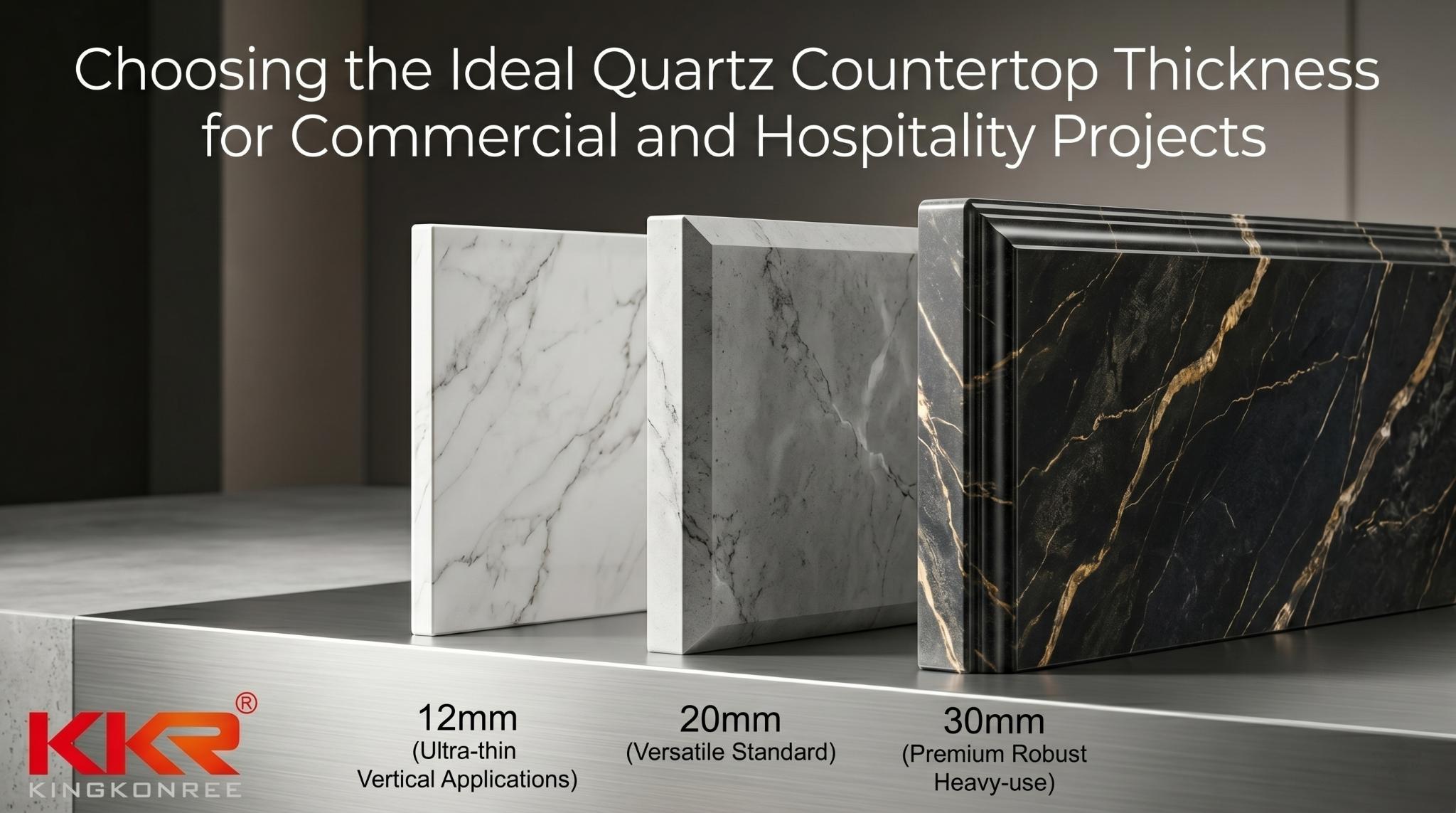
Hotels, retail stores and restaurants, which have high traffic areas, need to choose the correct thickness. It helps ensure that the space is safe and commissioned correctly to engineering requirements. There are three main thicknesses used in commercial settings: 12mm, 20mm and 30mm. Why did the engineers make these three thicknesses? We will answer that in the next section. By understanding the pros and cons of each thickness, we can analyze the commercial project’s longevity while ensuring sophisticated design.
Understanding Standard Quartz Countertop Thickness Options
The Role of 12mm and 15mm Slabs
While the dimensions 12mm and 15mm are exceptionally thin, they can be laid horizontally for a countertop only if they are fully supported. Otherwise, they are primarily feasible for upright surfaces where keeping the weight down is critical. They are ideal for covering walls, backsplashes, and areas around the fireplaces. Extraordinary designs are their key feature, which include avant-garde and modern aesthetics.
The key is to utilize them in areas where there are minimal impacts. For instance, the guest room vanity, integrated furniture component, custom desk top, and decorative store display. As the material is very thin, it is highly fragile. It requires reinforcements like a layer of wood or drywall underneath to prevent it from cracking under localized stress.
For handling, thin slabs have significantly less weight, which allows workers to move them with ease and cut down the transport charges. As the shipment process is easy, it makes large-scale international procurement ideal.
Versatile 20mm Quartz
The 20mm thickness is the most common choice for modern homes and light commercial projects. It is the most popular Quartz thickness owing to the balance between affordability and durability. It offers minimalist aesthetics while ensuring strength to handle loads that are associated with horizontal placement. They are cost-effective for bulk procurement in large hotel projects, there are minimal shipping and handling costs.
While the 20mm is thick, it offers better strength in comparison to the 12mm. In applications where you require the counter to stick out, like for the seating area, that extension cannot be more than 8 inches. Otherwise, you will need a supporting structure underneath to protect the material from breaking or the structure from collapsing.
The 20mm Quartz material is typically made up of 8 to 11% of resin content, which is primarily Unsaturated Polyester Resin (UPR). It allows it to flex just enough to prevent cracking when exposed to thermal changes. The thickness and the material characteristics allow Quartz countertop edges to be cut in 45-degree angle. It also allows designers to build hollow-edge designs to make the counter look heavy without adding additional weight that comes with 40mm or 50mm blocks.
Premium 30mm Quartz
When budget is not the constraint and robustness, or luxury is the goal, a 30mm Quartz countertop becomes ideal. The size offers the best protection against breaking, chipping and cracking. The thickness makes it feasible to handle heavy weights safely. These are specifically ideal for high-activity commercial applications like restaurants. It can support heavy restaurant equipment and also allow significant cantilevered overhangs without breaking.
Another big advantage of a 30mm quartz countertop is that you can install it directly onto the cabinet without any reinforcement. They can handle the weight without sagging or cracking under load. The extra thickness also makes it the top choice for luxurious aesthetics, particularly for grand hotel lobby reception desks. The thicker cross-section allows fabricators to make intricate edge profiles. These can be full bullnose or ornate traditional carvings. The surface is so thick that it looks like a permanent part of the building. These are ideal for luxury commercial real estate as buyers perceive them to be of higher value.
to enhance the feel of the material manufacturer, lower the resin-to-quartz ratio. The resin is actually 7% to 8%, which makes the material feel much more robust to the touch. The tactility makes the engineered stone look much more like natural granite.
How Thickness Affects Countertop Performance
Structural Integrity
The material is engineered into existence. It is specially designed to provide structural integrity. However, the performance changes drastically with thickness.
- Bending: 30mm or 20mm quartz countertops are suitable when it comes to resistance against bending. Their rigidity is vital to prevent hairline fractures that can occur at high-stress points. These are areas around holes that have been cut to allow fitting of sinks and cooktops.
- Unsupported Edges: For unsupported edges, 30mm offers the maximum overhanging capability. They can be used to build bar counters or breakfast nooks. There is a minimal requirement for bracing. In contrast, 20mm would require supports to prevent it from snapping into pieces.
- Impact Resistance: For commercial applications, the 30mm quartz is the ideal choice. It can handle typical impacts of high-traffic commercial kitchens, like dropping heavy utensils or equipment. Under such loads, a 12mm or 20mm slab will shatter or chip.
- Vibrations: The heavy and dense structure absorbs the vibrations with the 30mm slab. Commercial equipment such as dishwashers or blenders can transfer vibrations to the quartz countertop, damaging thinner varieties.
Edge Profiles and Design Flexibility
Interior designers like the versatility that comes with quartz countertops. They offer excellent machinability and fabrication characteristics. However, the degree of design flexibility depends on the thickness.
- Visual Proportionality: The thickness should be in line with the other dimensions of the room, including the ceiling height and size of the cabinets. Thicker pieces 30mm+ are ideal for massive commercial spaces. Thinner 20mm are ideal for smaller and cozier settings such as boutiques.
- Waterfall Edges: Both 20mm and 30mm are perfect for this waterfall edge effect. The quartz countertop material is cut at an exact 45-degree angle and joined with mitered edges to create the illusion of a smooth bend.
- Advanced Profiles: For detailed borders, 30mm thickness is vital. It allows shapes like Ogee or three stacked and rounded edges to be fabricated. There is enough vertical space to carve those details into the profile.
- Modern Aesthetics: The rounded edge or sanitary eased edges are the most go-to options as they prevent people from getting hurt and give a crisp, clean, up-to-date look.
- Mitered Illusions: The clever trick that most designers use is taking a 20mm slab and attaching angled pieces at the front to create a built-up edge. It can make a counter look 60mm or even 100mm thick without the extra weight of using the whole countertop.
- Polish: Another way you can make a quartz countertop with veining stand out is to use a high-gloss finish. Conversely, the use of matte finish on a 20mm slab creates a modern, uncluttered look which feels soft to touch.
Matching Quartz Countertop Thickness to Different Commercial Applications
Hospitality and Hotel Projects
Hotel bathrooms typically have light usage, which makes a 20mm thickness ideal. It is light enough to allow minimalist cabinets to handle the weight. For large-scale hotel orders, sticking to the 20mm thickness ensures that there is color consistency and better dimensional accuracy.
In higher traffic areas like the lobby, using a 30mm quartz countertop is ideal. It can handle the day-to-day banging of heavy suitcases and the guest interaction of a busy reception. For luxury hotel brands, 30mm thickness slabs with custom edges carved into the material are ideal. It creates a powerful image of opulence and permanence. They also offer anti-fungal properties that are vital for rigorous sanitization requirements of hospitality applications.
Retail and Food Service Spaces
For shops and jewellery stores, quartz countertops offer the premium aesthetic. Most shop owners prefer light colors with intricate veining patterns to make the room look big. The slabs provide structural stability, making the whole setup look expensive. For retail kiosks in commercial applications, a bended quartz countertop creating waterfall islands creates a tough shield to protect against the bumping of shopping carts and strollers.
The 12mm slabs can be used by brands to cover the walls if they want the wall to match their countertops. Ensure the same supplier is used for wall cladding and countertops.
Commercial Kitchens and Hygiene Standards
The biggest advantage of a quartz countertop is the NSF/ANSI 51 compliance. The material is formally approved to be in contact with food. Unlike natural stones that require a synthetic layer for protection, these are naturally non-porous. It allows it to have better strength and prevent unhygienic conditions caused by bacteria, mold, mildew and fungus. There are no harborage areas that health inspectors may penalize in a commercial kitchen.
Professional strong emphasis on using the 30mm thickness in commercial kitchens. They can handle the stress caused by thermal cycling of hot and cold temperatures. However, it’s important to consider that quartz countertops are not heat-proof. The large thermal mass of the 30mm slab allows some protective buffer for brief contacts or hot pans and pots.
Cost, Fabrication, and Long-Term Value Considerations
Initial Material and Installation Costs
When you order a Quartz slab, it typically comes in standardized 126” x 63” sizes. A smart designer will analyze the interior and use minimal material to ensure the reduction of waste. Expect an additional 20% to 30% charger as a labor premium for installation in a business in comparison to a regular home. The extra cost comes from tighter deadlines and strict regulatory compliance.
To analyze the material cost, we can categorise the quartz countertop into three parts:
- 12mm: It is the most inexpensive one when it comes to initial material cost. For installation, it will require a layer of wood built underneath the countertop. The additional layer of wood adds to the increased labor costs.
- 20mm: As the moderate option with the most sales, it is the smartest choice for a quartz countertop. It provides the ideal balance between what you pay for the initial cost and the installation costs that come with it.
- 30mm: It is the highest for material cost. However, it also requires a stronger structure below the countertop. It means spending money on reinforcing cabinetry and paying for an extra crew member for material handling.
Long-Term Maintenance and ROI
Unlike granite or marble, quartz countertops do not require regular sealing. It means you save thousands of dollars for upkeep of the material during its lifecycle. Investing right at the beginning in 30mm quartz can significantly increase the value of the material for high-traffic commercial zones.
If any accident happens, professionals can fill the Quartz damage area with dyes that match the resin. The repair appears seamless, which gives the material its decades of life. Finally, the material is non-porous. It gives it the best hygiene ROI. It creates a much safer environment for everyone. It also reduces the risk of failing to comply with government requirements.
Working with an Experienced Surface Manufacturer
KKR’s Quartz Surface Solutions for Commercial Projects
Partnering with an experienced quartz countertop manufacturer can help you pick the right thickness. Their team of experts can guide clients with their massive feedback database from various projects worldwide. They can handle shipping to 126 countries, provide 10-year warranties and provide 3D waste reduction planning tools.
Why Manufacturing Capability Matters
KingKonree (KKR) has a massive 25,000 sq meter facility that can ensure exact color matching and precision cutting. Their advanced machines create smooth joints and, with strict quality control, guarantee 8% resin in their quartz. They can ensure high-capacity production in line with your project deadlines.
Recommended Applications for KKR Quartz Countertops
KKR offers up to 5 thickness variations and 300 color options. Their product offers zero silica quartz, perfect for the following key applications:
- Luxury Hotels
- High-Traffic Restaurants
- Hygienic Hospital Surfaces
- Retail Displays
- Apartments
Conclusion
The right thickness for a commercial application is a matter of strategy. You want to see the quartz countertop match your architectural vision. The business needs to operate with commercial viability. The ultimate success is making sure that the material can handle the wear and tear of a commercial setting.
In conclusion, for commercial applications, go for the 20mm in case you need a sleek and modern profile, such as in a boutique hotel. Consider 30mm for robust performance and luxurious presence in high-volume restaurants. Reserve 12mm and 15mm quartz primarily for commercial wall cladding and low-impact vertical surfaces, as the cost of reinforcing them for heavy-duty horizontal use defeats the purpose of their affordability.
For an international project, ensuring that the product has exact precision and long-lasting toughness with 300 color options, you need KingKonree (KKR). Their 24 years of experience make them experts in custom quartz fabrication for hospitality projects and luxury commercial projects.
Visit KingKonree (KKR) to learn more.
FAQ
Q: What is the standard quartz countertop thickness?
The standard quartz countertop thickness is 20mm. However, the variation changes with region. The United States standard for a countertop is 30mm. 20mm is common on the West Coast. The 12mm variation is mostly used in vertical claddings.
Q: Is 20mm or 30mm quartz better for hotel projects?
It depends on the application. For guest bathrooms, 20mm is a viable option as it balances cost and weight with sufficient durability. A 30mm quartz countertop is recommended for lobbies, reception desks and bar counters where large traffic is expected.
Q: Does a thicker quartz countertop mean better durability?
Yes higher thickness of the quartz countertop means better resistance to chipping and impacts. It is less prone to chipping at the points where cutouts are made. There is no need for support. 30 mm-thickness slabs can be overhung on the edge without support.
Q: What quartz countertop thickness is best for waterfall islands?
In commercial applications, 20mm thickness is considered ideal for waterfall islands. When fabricated with precise mitered joints, it offers a luxurious aesthetic and architectural grounding. These are often combined with mitered edges for the dramatic solid block look.
Q: Can thin quartz countertops crack more easily?
The thinner profiles, 12mm to 20mm, are inherently more fragile and vulnerable to cracking. Especially the 12mm thickness, which requires wooded support to prevent cracking. The localized chipping on the edge can also occur during shipment.