







Choosing between Corian vs granite countertops depends on your budget, design preferences, maintenance expectations, and daily kitchen activities. Both materials are suitable for kitchens and bathrooms, but they differ in composition, appearance, heat resistance, durability, and repairability.
Corian is a nonporous acrylic solid-surface material known for its repairable finish, flexible designs, and less-visible joints. Granite is a natural stone valued for its distinctive patterns, hardness, and strong resistance to heat and scratching.
For homeowners who prefer consistent colors, integrated sinks, and easier surface refinishing, Corian may be suitable. Granite is worth considering when natural stone appearance and resistance to everyday wear are the main priorities.
This guide compares eight important differences between Corian and granite countertops, including installation costs in the USA, maintenance, applications, and long-term value.
Corian vs Granite at a Glance
| Feature | Corian Countertops | Granite Countertops |
| Material | Acrylic resin and mineral fillers | Natural igneous stone |
| Appearance | Consistent colors, patterns, and custom shapes | Unique natural colors, veining, and mineral patterns |
| Installed Cost | Approximately 40–65 per sq. ft. in one 2026 comparison | Approximately 50–200 per sq. ft. in the same comparison |
| Scratch Resistance | Scratches more easily but can often be refinished | Generally more resistant to scratching |
| Heat Resistance | Moderate; hot cookware may cause damage | High, but not immune to thermal shock |
| Porosity | Nonporous | Varies by stone; some may benefit from sealing |
| Maintenance | Routine cleaning; no sealing required | Routine cleaning; sealing depends on the stone |
| Seams | Inconspicuous when properly fabricated | Usually more visible |
| Repairability | Minor scratches can often be refinished | Chips and cracks may need professional stone repair |
| Installation | Can support custom shapes and integrated sinks | Heavy slabs require careful handling and support |
Both materials offer practical advantages. The better option depends on how the countertop will be used and the appearance you want to achieve.
1. Corian vs Granite: Material Composition
The first major difference is how these countertop materials are made.
Corian is a branded solid-surface material originally developed by DuPont. It consists primarily of acrylic resin and natural mineral fillers, particularly alumina trihydrate.
According to Corian’s technical documentation, its solid-surface sheets contain approximately one-third acrylic resin and two-thirds natural minerals.

This produces a relatively uniform, nonporous material that can be cut, shaped, joined, and refinished using appropriate fabrication methods.
Granite, by comparison, is a naturally occurring igneous rock formed as molten material cools beneath the Earth’s surface.
It commonly contains quartz, feldspar, mica, and other minerals, which contribute to its hardness, color, and distinctive patterns.
Granite is quarried in blocks and cut into slabs before being polished and fabricated into countertops.
An important distinction is that Corian is a specific brand, while solid surface is a broader material category. Other manufacturers, including KKR Stone, produce their own acrylic solid-surface products.
For additional information about these materials, read our guide to solid surface countertop materials and performance.
2. Corian vs Granite: Appearance and Design Options
Corian and granite offer different visual characteristics.
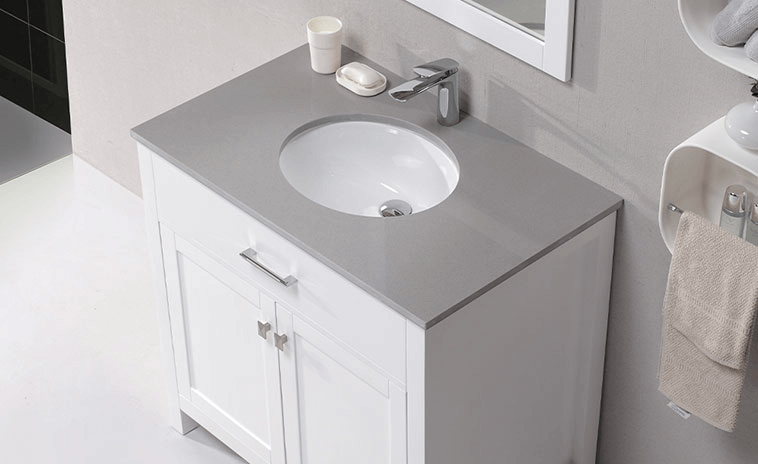
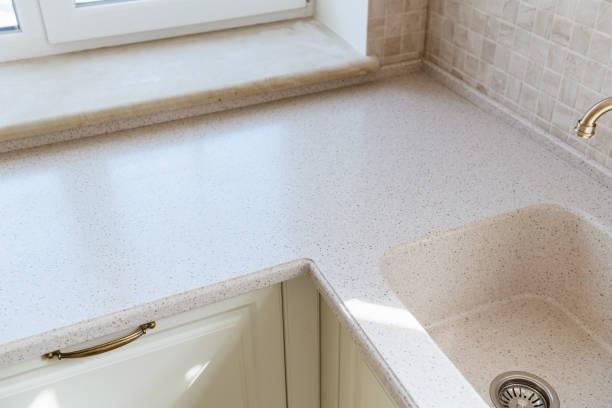
Corian is available in solid colors, speckled patterns, and designs inspired by natural stone. Its consistent material composition makes it useful for projects requiring coordinated colors and less-visible joints.
It can also be fabricated into curved shapes and combined with compatible sinks and backsplashes.
These features make Corian suitable for modern kitchens, bathroom vanities, reception desks, and other customized interiors.
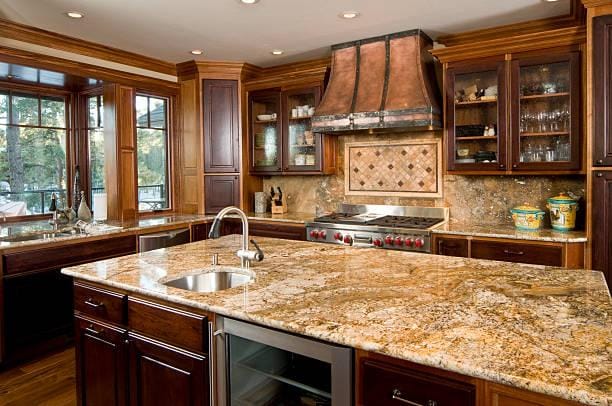
Granite provides a distinctly natural appearance.
Every granite slab contains variations in mineral distribution, color, and pattern. Depending on the stone, these may include subtle speckles, flowing movement, or dramatic contrasting veins.
Granite colors range from white and beige to gray, brown, green, and black.
You can explore different granite countertop colors to understand how natural patterns affect kitchen and bathroom designs.
Which looks better?
There is no universal winner. Corian suits projects requiring consistent finishes, curved forms, and coordinated surfaces. Granite appeals to homeowners who prefer natural stone patterns and variation between slabs.
3. Corian vs Granite Cost
The cost of Corian vs granite is one of the most important considerations for homeowners planning a kitchen renovation.
A 2026 US countertop price comparison published by HomeGuide reports these installed-price estimates:
| Countertop Material | Estimated Installed Cost per Square Foot |
| Corian | 40–65 |
| Granite | 50–200 |
These figures provide a comparison rather than guaranteed installation prices. Other published estimates report wider and overlapping ranges, particularly for Corian.
For example, a broader countertop cost guide estimates Corian at approximately 50–150 per square foot installed. This illustrates why local quotations are more useful than relying on a single national price range.
Why Countertop Prices Vary
Several factors influence the final installed cost:
- Material selection: Premium colors, unusual patterns, and specialty finishes may cost more.
- Thickness and dimensions: Larger or thicker sections may require more material.
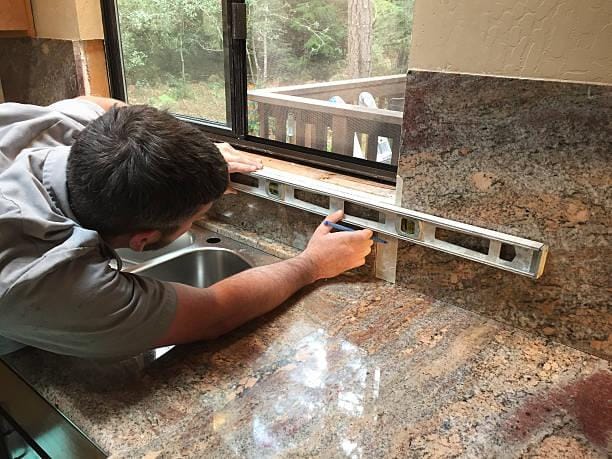
- Countertop layout: Islands, corners, and complex layouts affect fabrication.
- Edge profiles: Decorative edges can increase labor costs.
- Sink cutouts: Undermount and integrated sinks require additional work.
- Location: Labor and material availability differ across US markets.
- Installation: Delivery, removal of existing countertops, and structural preparation affect the final quote.
Entry-level granite can sometimes cost less than premium Corian. Similarly, complex solid-surface fabrication may cost more than a straightforward granite installation.
For an accurate comparison, request quotations based on the same countertop dimensions and installation requirements.

4. Durability, Scratches, and Repairability
Both countertop materials can provide years of use when properly maintained, but they respond differently to damage.
Corian Durability
Corian can develop scratches from knives, abrasive objects, and everyday contact.
Cutting directly on its surface is not recommended.
One important advantage is repairability. Because Corian is a relatively uniform solid-surface material, many minor scratches and surface imperfections can be removed through approved refinishing methods.
The appropriate process depends on the countertop’s finish. Matte surfaces are generally easier to restore than high-gloss finishes, which may require professional equipment.
For detailed repair guidance, see how to polish Corian countertops.
Granite Durability
Granite is generally harder and more scratch-resistant than Corian.
It usually tolerates everyday contact with cookware and kitchen accessories well. However, dragging abrasive objects across the surface can still cause damage.
Granite may also chip around edges or sink openings if struck by heavy objects.
Small chips can sometimes be repaired with suitable fillers, while larger damage may require professional stone restoration.
Which is more durable?
Granite generally performs better against scratching and hard impacts during everyday kitchen use. Corian offers an advantage when minor surface scratches need refinishing.
Hardness and repairability are different qualities, so neither should be used as the only measure of durability.
5. Corian vs Granite: Heat Resistance
Granite generally provides better heat resistance than Corian.
As a natural stone, granite can tolerate temperatures encountered in ordinary cooking environments. However, sudden or uneven temperature changes may cause thermal stress, particularly in vulnerable sections of a slab.
Using trivets remains a sensible precaution.
Corian contains acrylic resin, making it more sensitive to excessive heat.
Placing hot cookware directly on Corian can cause discoloration, scorching, or other damage.
The manufacturer recommends using heat-resistant pads or trivets beneath hot pans and portable heating appliances.
There is no single temperature limit that should be treated as a universal safe threshold for every Corian installation.
Which is better for heat resistance?
Granite has the advantage, particularly in kitchens where cooking activity is frequent. However, protecting both materials from direct contact with very hot cookware helps reduce the risk of damage.
6. Stain Resistance, Cleaning, and Maintenance
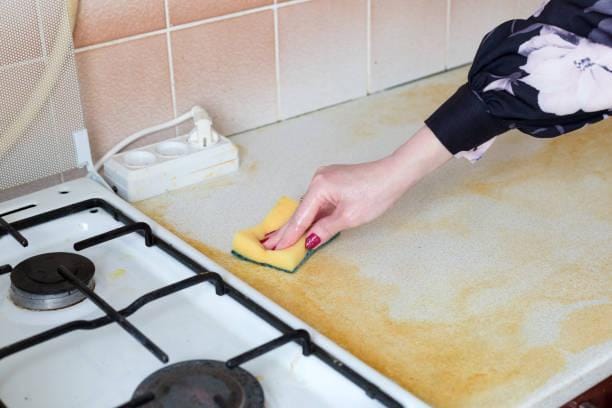
Corian and granite have different cleaning requirements because of their material composition.
Cleaning Corian Countertops
Corian is nonporous and does not require sealing.
Daily cleaning typically involves warm water, a soft cloth, and a suitable mild cleaner.
Many surface stains can be removed with manufacturer-approved cleaning methods. However, strong chemicals, inappropriate abrasives, and prolonged exposure to certain substances may damage the finish.
Routine cleaning is essential even though the material is nonporous.
For practical maintenance methods, read how to clean solid surface countertops.
Cleaning Granite Countertops
Granite can generally be cleaned with a soft cloth, warm water, and a suitable stone-safe cleaner.
Its susceptibility to moisture and staining varies according to the specific stone and any existing surface treatment.
Avoid assuming that household acids or harsh cleaners are appropriate for every granite countertop. Follow the stone supplier’s cleaning recommendations.
Does Granite Need Sealing?
Not every granite countertop requires regular sealing.
According to the Natural Stone Institute, many granite countertops do not need sealing, although some may benefit from an appropriate treatment.
The need depends on the particular stone, its existing treatment, and how the countertop is used.
A penetrating sealer improves resistance to moisture and staining, but it does not make the stone completely stain-proof.
What About Hygiene?
Corian’s nonporous surface supports convenient cleaning, while properly maintained granite can also be kept clean for food preparation.
Neither material should be described as automatically bacteria-free. Cleaning practices, spills, and surface condition remain important.

7. Installation, Weight, and Seams
Corian and granite require different fabrication and installation methods.
Corian sheets can be cut and shaped using suitable fabrication equipment. Compatible sections can be joined with color-matched adhesive to produce inconspicuous seams.
Fabricators can also create integrated sinks and backsplashes for selected designs.
Granite countertops are fabricated from natural stone slabs. Their weight requires careful transport, handling, and cabinet support.
Granite seams are generally more visible because the natural patterns on adjoining slabs may not match perfectly.
Corian is often lighter than a full-thickness granite slab, but the weight comparison depends on material thickness, countertop construction, and supporting components.
Both materials benefit from professional fabrication and installation, especially for large kitchen islands, sink openings, and complex layouts.
Which offers more installation flexibility?
Corian generally provides greater flexibility for curved designs, integrated components, and inconspicuous joints. Granite remains suitable for many kitchen layouts but requires careful planning around slab size, seams, and weight.
8. Applications and Long-Term Value
Corian and granite can be used in residential and commercial interiors, although certain applications favor different material properties.
Where Corian Works Well
Corian is commonly used for:
- Kitchen countertops and islands.
- Bathroom vanities and integrated sinks.
- Reception desks and office counters.
- Restaurant and hospitality surfaces.
- Healthcare and commercial worktops.
- Decorative furniture and wall applications.
Its nonporous construction, repairable finish, and design flexibility make it useful for projects requiring customized surfaces.
Where Granite Works Well
Granite is commonly used for:
- Residential kitchen countertops.
- Bathroom vanity tops.
- Kitchen islands.
- Restaurant and bar counters.
- Hotel reception areas.
- Decorative stone surfaces.
Its natural appearance, hardness, and heat resistance make it attractive for projects where visual character and everyday wear resistance are priorities.
Which Material Adds More Home Value?
Granite is often associated with premium natural-stone finishes, which may appeal to some homebuyers.
Corian can also be a practical choice for modern bathrooms and kitchens, particularly when its design and condition complement the rest of the property.
However, neither material guarantees a particular increase in resale value.
The quality of installation, overall kitchen condition, local housing market, and buyer preferences all influence the result.
Corian vs Granite vs Quartz: Quick Comparison
Engineered quartz is another popular countertop option frequently compared with Corian and granite.
| Feature | Corian | Granite | Engineered Quartz |
| Material | Acrylic solid surface | Natural stone | Mineral-rich engineered composite |
| Appearance | Consistent and customizable | Unique natural patterns | Consistent manufactured patterns |
| Scratch Resistance | Moderate | Generally high | Generally high |
| Heat Resistance | Lower than granite | Generally high | Heat-sensitive resin components |
| Sealing | Not required | Depends on stone | Generally not required |
| Repairability | Often easier to refinish | Professional stone repair may be needed | Repairs depend on type of damage |
| Seams | Can be inconspicuous | Generally visible | Generally visible |
Granite may suit buyers prioritizing natural stone and strong heat resistance. Quartz is often chosen for manufactured patterns and low routine maintenance, while Corian offers advantages in custom shapes and refinishing.
Which Is Better: Corian or Granite?
The right material depends on the countertop’s intended application.
Choose Corian When:
- You prefer consistent colors and coordinated surface designs.
- You want inconspicuous joints or integrated sinks.
- You value the ability to refinish many minor scratches.
- You need custom shapes or curved countertop designs.
- You prefer a nonporous surface that does not require sealing.
Choose Granite When:
- You prefer natural stone patterns and unique slab variation.
- Strong scratch resistance is a priority.
- You want better resistance to cooking heat.
- You like the appearance of polished natural stone.
- You are comfortable following stone-specific maintenance guidance.
For kitchens with frequent cooking and heavy daily use, granite may offer practical advantages. For bathrooms, custom interiors, and projects requiring integrated designs, Corian may be particularly useful.
The final decision should consider the installed price, maintenance requirements, and preferred appearance rather than relying on one material being universally better.
Frequently Asked Questions
Is Corian Cheaper Than Granite?
Corian can be cheaper than granite, particularly compared with premium natural stone. However, installed prices overlap depending on color, material grade, fabrication complexity, and location. Compare written quotes for the same countertop area and installation requirements before making a decision.
Does Corian Scratch More Easily Than Granite?
Yes. Corian generally scratches more easily than granite because its acrylic-based material is softer than natural stone. However, many minor Corian scratches can be refinished using approved methods, while damage to granite may require specialized stone repair.
Does Granite Need to Be Sealed Every Year?
No. Many granite countertops do not require annual sealing, and some do not need sealing at all. Requirements depend on the stone and its treatment. Follow the supplier’s advice and use an appropriate sealer only when needed.
Can Corian Look Like Granite?
Corian offers stone-inspired colors and patterns, including speckled and veined designs. However, natural granite has mineral variations unique to each slab. Corian is useful when consistent patterns are preferred, while granite provides a naturally varied appearance.
Explore Solid Surface Countertops From KKR Stone
Corian and granite are both established countertop options, but they are not the only materials available for residential and commercial projects.
KKR Stone manufactures its own acrylic solid-surface materials, including sheets, countertops, vanity tops, and custom fabricated components.
These products are distinct from genuine Corian-branded materials.
KKR Stone’s solid surface sheet collection includes different colors, patterns, and material options for fabrication projects.
The company also supports custom countertop manufacturing for kitchens, bathrooms, hospitality spaces, and commercial interiors.
Buyers comparing solid-surface alternatives can review the available specifications, request samples, and discuss customization requirements with KKR Stone.
Conclusion
Choosing between Corian vs granite countertops comes down to how you balance appearance, cost, maintenance, and performance.
Corian offers nonporous construction, less-visible joints, custom design flexibility, and the ability to repair many minor surface imperfections.
Granite provides unique natural patterns, strong scratch resistance, and generally better heat resistance.
Neither material is perfect for every application. Compare product specifications, installed costs, and long-term maintenance requirements to choose the countertop that best suits your project.