






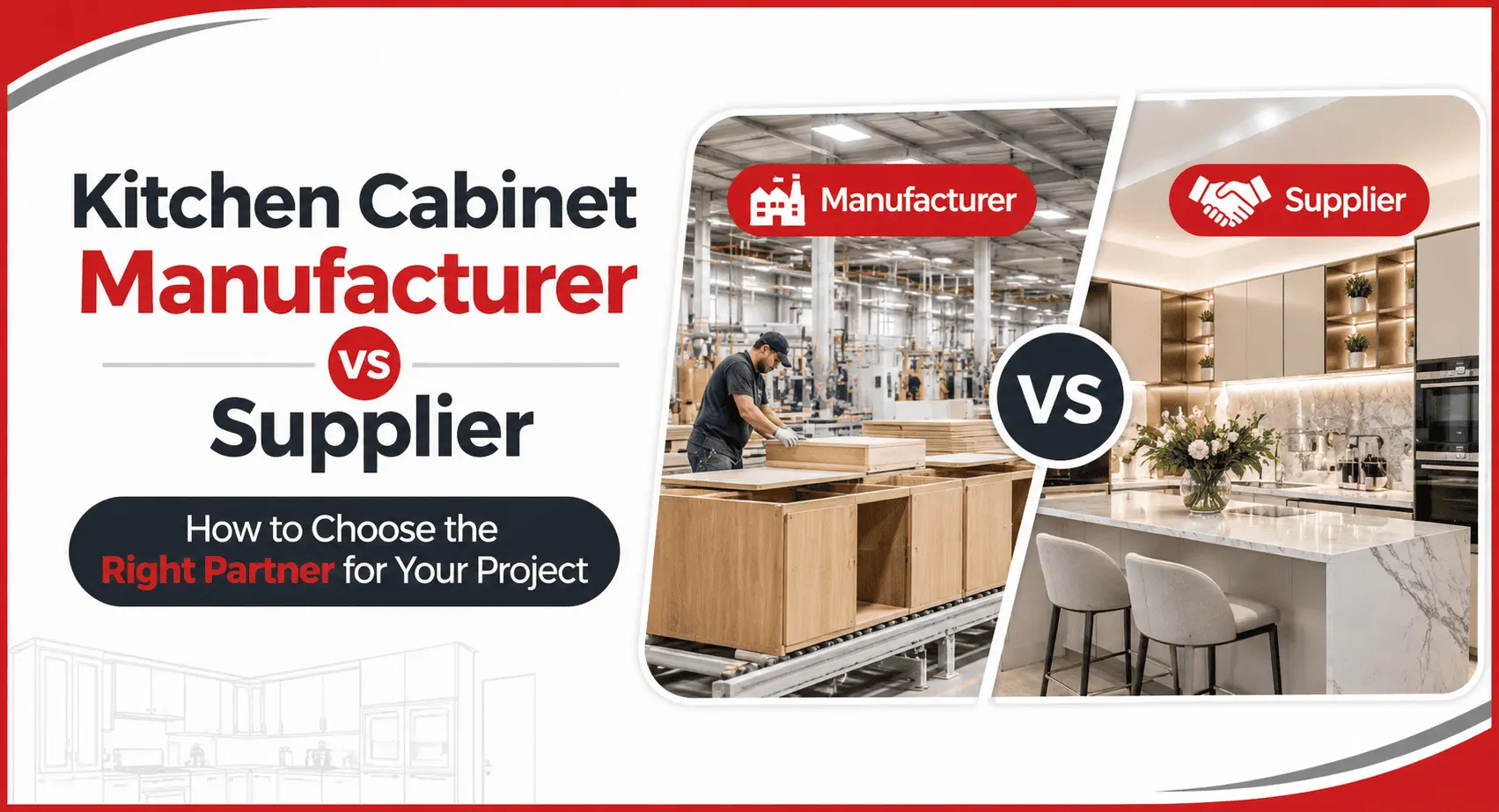
Comparing a kitchen cabinet manufacturer vs supplier is the fastest way for buyers, contractors, and designers to choose the right sourcing partner for their project. A kitchen cabinet manufacturer owns and operates the physical kitchen cabinet factory where raw wood, panels, and hardware are engineered and built into finished cabinets. A kitchen cabinet supplier is a commercial intermediary, such as a retail store, wholesaler, or online dealer, that buys finished cabinets from factories and resells them to customers. This guide compares both options side by side, explains how production and sourcing work, breaks down the main types of suppliers, and shows how contractors and designers decide between them.
Kitchen Cabinet Manufacturer vs Supplier: Side by Side Comparison
To help procurement teams, builders, and homeowners evaluate both options quickly, the table below compares a direct kitchen cabinet manufacturer against a traditional kitchen cabinet supplier across ten key factors.
| Comparison Factor | Kitchen Cabinet Manufacturer (Factory Direct) | Kitchen Cabinet Supplier (Distributor or Dealer) |
| Primary Role | Engineers, fabricates, finishes, and tests cabinets in house from raw materials | Buys finished or flat packed cabinets in bulk to warehouse, market, and resell |
| Customization Capability | High; supports custom dimensions, bespoke finishes, shaker or modern profiles, and architectural layouts | Low to Moderate; usually restricted to the standard SKUs and sizes stocked in their catalog |
| Pricing Structure | Factory direct pricing with no distributor or showroom middleman markup | Includes a 20% to 50%+ wholesale or dealer markup to cover warehousing and local overhead |
| Minimum Order Quantity (MOQ) | Typically requires a project minimum (such as 10 to 30+ sets or a container load) | Low; buyers can purchase a single replacement cabinet or one small kitchen at a time |
| Production and Delivery Lead Time | Longer; includes drawing approval, factory fabrication, and ocean or freight transit | Shorter for in stock items; often ships within 3 to 14 business days from a local warehouse |
| Countertop and Sink Integration | Factories with stone and solid surface workshops can pre fit countertops and sinks to the exact cabinets | Rarely fabricates countertops in house; requires hiring a separate local stone fabricator |
| Quality Control Accountability | Direct control over raw panel grades, moisture content, finish curing, and pre shipment inspection | Relies on the upstream factory’s quality control; limited ability to fix manufacturing defects |
| OEM and Private Label Support | Full support for custom branding, exclusive door designs, and branded carton packaging | Not available; suppliers sell existing brands rather than manufacturing private label lines |
| Design and Technical Support | In house CAD and 3D engineering teams working directly on large project blueprints | Kitchen showroom designers focused on single room residential layouts |
| Best Suited For | Multifamily developments, hotels, custom home builders, cabinet dealers, and wholesale buyers | Single kitchen remodels, emergency replacements, and projects needing immediate local delivery |
How Manufacturers Produce Cabinets vs How Suppliers Source Them
Looking inside the operational workflow of both business models explains why pricing, lead times, and quality consistency differ on a job site.
Inside a Kitchen Cabinet Factory
When an order enters a professional kitchen cabinet factory, production follows a strict engineering sequence rather than simple box assembly:
- Blueprint Engineering and 3D Modeling: Production engineers convert architectural floor plans into precise 2D CAD shop drawings and 3D cabinet diagrams, verifying appliance cutouts, plumbing clearances, and wall runs before a single board is cut.
- Substrate Selection and Moisture Conditioning: Raw lumber, hardwood plywood, Medium Density Fiberboard (MDF), or particleboard is conditioned so moisture content remains at 10% or less at the time of fabrication, preventing doors and panels from warping after installation.
- Precision CNC Machining and Edge Banding: Computer Numerical Control (CNC) machines cut cabinet panels, drill European hinge cup bores, and mill joinery slots to sub millimeter tolerances, followed by automated high temperature edge banding that seals panel edges against kitchen humidity.
- Surface Finishing and Curing: Whether producing custom straight line wood grain kitchen cabinets, timeless shaker doors, or sleek matte modern fronts, factories apply multi coat primers, UV cured lacquers, or high durability laminates in dust controlled booths to ensure color fastness and smooth textures.
- Pre Assembly Trial and Multi Step Quality Control: Reputable kitchen cabinet manufacturers dry fit complex runs, inspect door alignment and finish consistency across a multi step quality inspection process, and pack units with protective corner bracing for transit.
How Kitchen Cabinet Suppliers Source Inventory
Most kitchen cabinet suppliers operate on an inventory turnover model. To keep warehouse storage costs predictable, a cabinet supplier selects five to ten popular door styles (such as white shaker, gray shaker, or espresso flat panel) and orders them in bulk from domestic or overseas factories.
The supplier stores these flat packed boxes on warehouse racks. When a contractor orders a kitchen, warehouse staff pull the closest standard widths from the shelf and add filler strips to bridge any leftover wall gaps. If a project requires a non standard depth, a custom wood grain match, or custom L shaped wood grain kitchen cabinets built to exact architectural dimensions, a stock supplier cannot modify the boxes in their warehouse. They must either decline the customization or forward the special order back to a cabinet manufacturer, adding both a middleman markup and extra communication layers to the timeline.
Types of Kitchen Cabinet Suppliers
When buyers choose not to order directly from a large scale industrial factory, they typically work with one of four common types of kitchen cabinet suppliers in the US market:
1. Local Custom Cabinet Makers
Local custom cabinet makers are small, independent woodworking shops that build made to order cabinets for individual homeowners and local remodelers. While they actually fabricate cabinets in a local shop, they function as high touch local suppliers for single home projects, offering personalized on site measuring, bespoke millwork, and local installation at a high per cabinet labor cost and limited production capacity.
2. Big-Box Retailers (e.g. Lowe’s, Home Depot)
National home improvement retailers act as mass market kitchen cabinet suppliers by partnering with major stock and semi custom cabinet brands. They offer convenient in store displays, financing options, and off the shelf stock cabinets for quick DIY pick up, though buyers pay retail markups and are limited to the specific styles, finishes, and modular sizes carried by the store’s vendor catalog.
3. RTA (Ready-to-Assemble) & Online-Only Stores
Online RTA suppliers import flat packed cabinets in bulk from overseas factories, store them in domestic fulfillment warehouses, and ship them directly to buyers across the country. Because the customer or contractor assembles the cabinet boxes on site using cam locks, brackets, or wood glue, RTA stores offer fast shipping and lower prices for standard kitchen layouts, but provide very little dimensional customization.
4. Direct-to-Consumer (DTC) Cabinet Suppliers
Direct to consumer cabinet brands operate digital storefronts or boutique design studios that sell pre assembled or flat packed cabinets directly to homeowners and trade professionals without traditional dealer networks. Many DTC suppliers offer free online 3D design rendering and curated modern or shaker collections, bridging the gap between basic online RTA stores and traditional brick and mortar showrooms.
Contractors & Designers: Which Do They Choose, Manufacturer or Supplier?
General contractors, commercial builders, and interior designers do not rely on a single sourcing channel for every job; instead, they match the partner to the project’s unit count, design complexity, and schedule.
- When Contractors & Designers Choose a Supplier: For single family kitchen remodels, house flips, or insurance repairs with a 1 to 3 week turnaround, contractors and designers usually buy from a local kitchen cabinet supplier or DTC trade program. Trade accounts give them quick access to stocked white shaker or flat panel boxes, local delivery, and easy single box replacements if a door is damaged on site.
- When Contractors & Designers Choose a Manufacturer: For multifamily apartment complexes, hotel developments, senior living facilities, or high end custom homes, commercial contractors and design firms bypass local middlemen and partner directly with a kitchen cabinet manufacturer. Buying kitchen cabinet wholesale directly from the factory reduces unit costs by 20% to 50%, unlocks custom floor to ceiling millwork and exact color matching, and allows designers to coordinate cabinets with factory pre fitted countertops and sinks under one set of CAD shop drawings.
How to Choose Between a Kitchen Cabinet Manufacturer and a Supplier
The right choice depends on your project volume, timeline, and level of design customization:
When to Choose a Kitchen Cabinet Supplier
- Single Home Remodels with Tight Deadlines: If you are renovating one residential kitchen and need cabinets on site within 7 to 10 days, a local kitchen cabinet supplier with stocked warehouse inventory is the most practical route.
- Standard Layouts Using Off the Shelf Sizes: If your floor plan fits standard 3 inch incremental boxes and basic shaker or flat panel finishes without custom millwork, stock suppliers can fill the order quickly.
- Small Replacement Orders: When a property manager needs two replacement base cabinets after a plumbing leak, buying from a local retail or wholesale supplier avoids factory MOQs.
When to Choose a Kitchen Cabinet Manufacturer
- Multifamily Apartments, Hotels, and Commercial Developments: When outfitting 20 to 500+ residential units or hospitality suites, buying directly from a kitchen cabinet manufacturer protects project margins and guarantees batch to batch color and hardware consistency across every floor.
- Bespoke Architectural and Luxury Home Projects: When architects specify full height wall storage, concealed appliance panels, custom wood grain textures, or coordinated stone and solid surface islands, a custom manufacturer translates those drawings into reality without forcing compromises.
- Cabinet Dealers, Wholesalers, and Private Label Brands: If you run a kitchen showroom or regional distribution business, partnering directly with an OEM and ODM kitchen cabinet factory allows you to build exclusive product lines, customize carton branding, and capture higher wholesale margins.
Frequently Asked Questions
Q1. What is the difference between a cabinet manufacturer and a supplier?
A kitchen cabinet manufacturer builds cabinets from raw materials inside its own factory, whereas a kitchen cabinet supplier buys finished cabinets from manufacturers and resells them to contractors or homeowners.
Q2. Is it better to buy kitchen cabinets directly from a manufacturer?
Buying directly from a kitchen cabinet manufacturer is better for custom, wholesale, and multi-unit projects that need factory-direct pricing and tailored dimensions, while buying from a supplier is better for fast, single-kitchen stock orders.
Q3. Are kitchen cabinet manufacturers cheaper than suppliers?
Yes, kitchen cabinet manufacturers are cheaper per unit on project and wholesale orders because there is no middleman markup, though local suppliers can cost less for small one-off orders once minimum order quantities and freight are factored in.
Q4. Can a cabinet manufacturer provide custom cabinets and countertops together?
Yes, full-service manufacturers like KKR Stone fabricate both made-to-order kitchen cabinets and matching custom countertops with integrated sinks in a single coordinated shipment.
Q5. How do I verify the quality of an overseas kitchen cabinet factory before ordering?
You can verify a kitchen cabinet factory by requesting physical door and finish samples, reviewing ISO 9001 and SGS certifications, approving 3D CAD shop drawings, and confirming pre-shipment quality inspection steps.
Partner with KKR Stone for Custom Kitchen Cabinets and Countertops
Whether you are sourcing cabinetry for a multifamily apartment complex, a hotel development, a high end residential build, or a wholesale distribution business, working directly with an experienced manufacturer streamlines your supply chain.
With over 20 years of manufacturing expertise, a 15,000 m² production facility, and projects delivered across more than 100 countries, KKR Stone combines custom cabinetry fabrication with solid surface and stone countertop production. Our engineering team supports contractors, designers, and brand owners with:
- Made to Order Cabinet Configurations: Explore our full range of custom kitchen cabinets, including modern handleless designs, classic shaker profiles, straight line and L shaped layouts, and full wall storage systems.
- One Stop Countertop and Sink Pairing: Pair your cabinetry with bespoke solid surface, quartz, or stone countertops engineered to +/- 0.5 mm joint tolerances, complete with integrated or undermount kitchen sinks.
- 3D Design and Container Optimization: Our in house design team transforms your architectural drawings into 3D cabinet layouts and container loading plans that maximize freight efficiency.
- Strict 5 Step Quality Control: As an ISO 9001 audited manufacturer with CE, SGS, and CUPC certifications, every order undergoes rigorous inspection from raw material selection to wooden crate packaging.
Ready to discuss your project specifications, request free material samples, or compare factory direct wholesale pricing? Contact the KKR Stone team today to get a custom quote and 3D layout consultation for your next project.