







A solid surface countertop is an engineered worktop made from a combination of mineral fillers, acrylic or polyester resins, and pigments. It provides a non-porous, durable, and customizable surface commonly used in kitchens, bathrooms, and commercial interiors. Unlike natural stone countertops, solid surface materials are manufactured to provide consistent colors, patterns, and fabrication options. They can also be joined using color-matched adhesives, producing an almost seamless appearance.
Solid surface countertops are often considered alternatives to granite, quartz, and laminate because they offer design flexibility, straightforward maintenance, and the ability to repair many types of surface damage. However, solid surface materials are more susceptible to scratches and heat damage than some other countertop options.
This guide explains what a solid surface countertop is, what it is made of, the available material types, its advantages and disadvantages, and how to choose the right product for residential or commercial projects.
What Is a Solid Surface Countertop?
A solid surface countertop is a manufactured surface consisting of mineral fillers bonded together with acrylic resin, polyester resin, or a combination of both.
The resulting material has a uniform composition throughout its thickness, unlike laminate countertops, which have a decorative surface bonded to a separate substrate.
Solid surface countertops were introduced commercially in the late 1960s, with DuPont’s Corian becoming one of the earliest and most recognized products.
Today, solid surface countertops are available from several manufacturers and are used in residential and commercial applications.
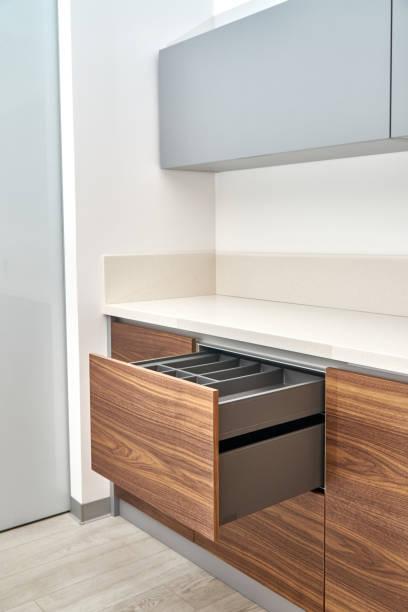
They are commonly selected for their smooth appearance, non-porous construction, and ability to create custom shapes.
Solid surface materials can also be fabricated into integrated sinks, backsplashes, curved countertops, and other architectural features.
What Does a Solid Surface Countertop Look Like?
A solid surface countertop can resemble natural stone, marble, terrazzo, or a plain-colored surface.
Available finishes include matte, satin, and polished appearances, depending on the material and fabrication process.
White solid surface countertops are particularly common in modern kitchens because they create a clean, consistent appearance.
Unlike natural stone, solid surface patterns are manufactured rather than formed through geological processes. This allows manufacturers to produce coordinated designs for multiple countertops.
What Is a Solid Surface Countertop Also Called?
Solid surface is sometimes referred to as an acrylic solid surface, engineered solid surface, or solid surface worktop.
Corian is a well-known brand of solid surface material, but it is not the name of the entire material category.
The term solid countertop is broader and may refer to several materials, including natural stone and engineered surfaces.
Similarly, a hard surface countertop is not necessarily a solid surface countertop. These terms should not be treated as interchangeable when specifying materials.
What Is a Solid Surface Countertop Made Of?
Solid surface countertops are made using three main components: mineral fillers, binding resins, and pigments.
Each ingredient contributes to the material’s appearance, structure, and performance.
1. Mineral Fillers
Mineral fillers form a substantial part of many solid surface formulations.
A commonly used filler is alumina trihydrate (ATH), a refined mineral compound derived from bauxite.
It provides bulk and contributes to the material’s physical properties.
For example, Corian’s material composition documentation describes its acrylic solid surface as approximately one-third acrylic resin and two-thirds natural minerals.
However, these proportions do not apply universally to every solid surface product.
2. Acrylic or Polyester Resins
Resins act as binding agents, holding mineral fillers and pigments together.
Acrylic resins, including polymethyl methacrylate (PMMA), are commonly used in solid surface products designed for fabrication and thermoforming.
Polyester resins are also used, particularly in formulations developed for specific visual characteristics or production requirements.
Some products combine acrylic and polyester resins to achieve a particular balance of cost, appearance, and performance.
3. Pigments and Decorative Additives
Pigments determine the countertop’s color and contribute to its decorative appearance.
Manufacturers can incorporate different pigments, particles, and visual effects to create solid colors, marble-inspired patterns, and terrazzo-like designs.
KKR Stone manufactures solid surface sheets in multiple color and pattern collections, including 100% acrylic solid surface materials and modified acrylic products.
The exact composition should always be confirmed through the manufacturer’s technical documentation.
3 Types of Solid Surface Countertops by Material
Solid surface countertops are generally classified according to their resin composition.
The three main categories are acrylic-based, polyester-based, and blended acrylic-polyester solid surfaces.
1. Acrylic Solid Surface Countertops
Acrylic solid surface countertops use acrylic resin as their primary binding material.
These products are widely used in kitchens, bathrooms, healthcare interiors, and custom architectural applications.
Acrylic solid surface is particularly valued for its fabrication flexibility.
Some acrylic formulations can be heated and shaped through thermoforming, allowing manufacturers to produce curved counters and customized designs.
Key characteristics:
- Non-porous construction.
- Suitable for color-matched adhesive joints.
- Good fabrication and customization flexibility.
- Repairable surface finishes.
- Available in multiple colors and patterns.
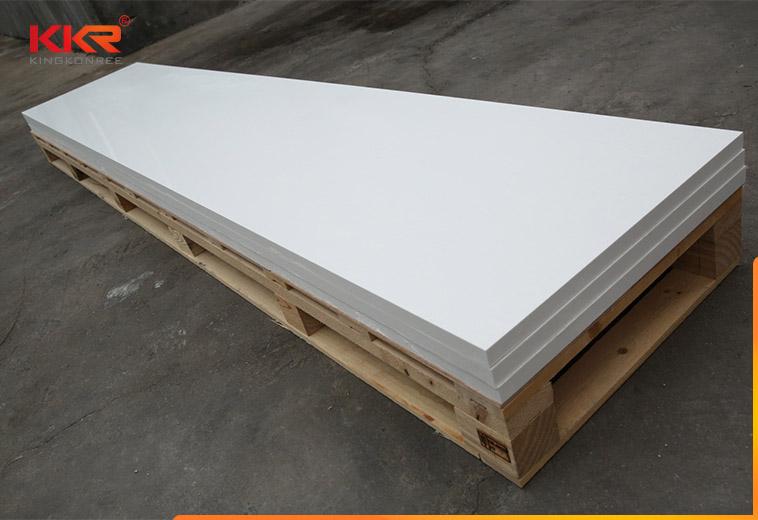
KKR Stone manufactures pure acrylic solid surface sheets in several thicknesses and dimensions, with customized specifications available for qualifying projects.
Acrylic solid surface is often preferred when complex shapes, coordinated colors, or integrated countertop components are required.
2. Polyester Solid Surface Countertops
Polyester solid surface countertops use polyester-based resins to bind mineral fillers and pigments.
Their appearance and performance depend on the resin formulation, manufacturing process, and quality of the materials used.
Certain polyester formulations can produce decorative finishes and may offer cost advantages over some acrylic alternatives.
However, polyester products should not automatically be considered more UV-resistant, durable, or heat-resistant than acrylic materials.
These characteristics vary by formulation and should be confirmed through testing.
Key characteristics:
- Available in multiple decorative finishes.
- Potentially lower material cost in some formulations.
- Suitable for selected molded products and countertops.
- Performance varies according to resin quality.
- Fabrication methods may differ from acrylic products.
For bathroom products exposed to temperature changes, resin selection and finished-product testing are especially important.
KKR Stone also uses specialized resin formulations for molded bathroom products, where thermal cycling, water exposure, and dimensional stability must be considered.
3. Acrylic-Polyester Blended Solid Surface
Blended solid surface materials combine acrylic and polyester resins in a single formulation.
These products are sometimes described as modified acrylic solid surfaces.
Manufacturers use blended formulations to balance characteristics such as fabrication, appearance, and production cost.
However, performance depends on the actual material composition rather than the term modified acrylic alone.
Before purchasing, review the material specifications and confirm its suitability for the intended application.
KKR Stone offers modified acrylic solid surface sheets alongside pure acrylic products for different project requirements.
For commercial projects, requesting samples and technical data helps buyers compare these formulations before ordering.
Applications of Solid Surface Countertops
Solid surface countertops are used in residential, commercial, and institutional environments.
Their non-porous construction, customizable dimensions, and coordinated finishes make them suitable for different interior applications.
Residential Kitchens
A solid surface kitchen countertop provides a smooth worktop for food preparation, serving, and everyday household activities.
It can be fabricated with integrated sinks, rounded edges, and matching backsplashes.
Solid surface is particularly useful for kitchens requiring long countertops or custom layouts where an inconspicuous joint is desirable.
However, cutting boards and heat protection should be used to avoid damage.
Bathrooms and Vanity Tops
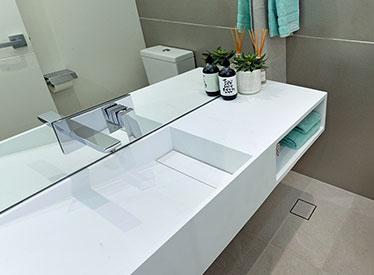
Solid surface is commonly used for bathroom countertops, vanity tops, integrated washbasins, and wall panels.
Its resistance to ordinary moisture exposure and relatively easy cleaning make it practical for bathroom installations.
Integrated sink designs can also reduce visible joints between the basin and countertop.
Commercial and Public Spaces
Commercial applications include hotel reception desks, restaurant counters, retail displays, office worktops, and hospitality interiors.
Solid surface can be fabricated into customized shapes and coordinated across several areas of a building.
KKR Stone supplies solid surface products for commercial interiors, including counters, furniture components, and fabricated surfaces.
Healthcare and Educational Facilities
Solid surface materials are also used in healthcare and educational environments where cleanability and controlled surface design are important.
Applications may include reception counters, washroom surfaces, and selected workstations.
However, laboratories and specialized healthcare facilities should verify chemical resistance, cleaning compatibility, and required technical certifications before specifying the material.
Solid Surface Countertops: Pros and Cons
Understanding the advantages and disadvantages of solid surface countertops helps buyers determine whether the material meets their functional and design requirements.
Pros of Solid Surface Countertops
1. Inconspicuous Seams
Solid surface sheets can be joined using color-matched adhesives to create an almost seamless appearance.
This is particularly useful for long countertops, kitchen islands, and custom commercial counters.
KKR Stone offers fabrication options supporting coordinated joints and continuous surface designs.
2. Non-Porous Surface
Solid surface countertops do not normally absorb liquids and generally require no sealing.
This makes them relatively straightforward to clean and maintain.
However, non-porous materials still require regular cleaning and appropriate sanitation. They are not automatically antibacterial.
3. Variety of Colors and Patterns
Solid surface countertops are available in solid colors, marble-inspired designs, terrazzo patterns, and other decorative finishes.
KKR Stone offers an extensive color and pattern selection, including custom matching options for qualifying projects.
This allows designers to coordinate surfaces with different interior styles.
4. Flexible Fabrication
Certain solid surface products can be thermoformed, cut, and joined into customized shapes.
This makes them suitable for curved countertops, integrated sinks, rounded edges, and decorative installations.
The achievable shapes depend on the material formulation and fabrication specifications.
5. Repairable Surface Damage
Minor scratches and certain surface marks can often be removed through sanding and refinishing.
This is an advantage over decorative laminate, where damage to the outer layer may be difficult to repair.
More extensive damage may require professional restoration.
Cons of Solid Surface Countertops
1. Susceptible to Scratches
Solid surface is generally softer than granite and engineered quartz.
Knives, abrasive cleaning equipment, and heavy objects can leave visible scratches.
Although many scratches are repairable, using protective accessories reduces unnecessary wear.
2. Sensitive to Excessive Heat
Hot pans and appliances can cause discoloration, scorching, or other damage.
Heat tolerance varies according to the material formulation, so there is no single temperature limit applicable to every solid surface product.
Use trivets and heat-resistant pads instead of placing hot cookware directly on the countertop.
3. Material Quality Varies
Acrylic, polyester, and blended solid surface products may have different performance characteristics.
Appearance alone is not sufficient to determine resin composition or manufacturing quality.
Request technical specifications, test reports, and warranty information before selecting a product.
Solid Surface vs Quartz: What’s the Difference?
Solid surface and quartz countertops are both engineered materials, but their compositions and performance characteristics differ.
Quartz countertops generally contain mineral aggregates combined with resins and pigments.
Solid surface countertops use acrylic or polyester resins with mineral fillers.
Quartz typically provides greater scratch resistance, while solid surface offers easier repair of many superficial scratches and greater flexibility for certain curved designs.
|
Feature |
Solid Surface |
Quartz |
|
Composition |
Resin and mineral fillers |
Mineral aggregates and resin |
|
Surface |
Non-porous |
Non-porous |
|
Scratch resistance |
Moderate |
Generally higher |
|
Heat resistance |
Limited |
Limited by resin content |
|
Seam appearance |
Often inconspicuous |
Usually visible |
|
Repairability |
Many scratches can be refinished |
Repairs can be difficult |
|
Curved fabrication |
Possible with suitable products |
More restricted |
|
Sealing |
Not normally required |
Not normally required |
Quartz is not usually classified as a solid surface countertop, even though both are manufactured materials.
What Is Better: Quartz or Solid Surface?
Quartz may be preferable when scratch resistance and a stone-like finish are priorities.
Solid surface can be a better choice when repairability, integrated sinks, curved designs, and inconspicuous joints are important.
Neither material is universally better. The decision should depend on the intended application, installation requirements, and maintenance expectations.
Is Solid Surface Cheaper Than Granite?
Solid surface countertops can cost less than some premium granite installations, but this is not always the case.
Granite pricing varies according to stone variety, slab dimensions, sourcing, and fabrication requirements.
Similarly, solid surface costs depend on resin formulation, manufacturer, thickness, color, and customization.
Complex curved surfaces and integrated features can increase fabrication costs.
Basic granite may be less expensive than premium solid surface, while specialized natural stone can cost considerably more.
Compare complete quotations that include material, fabrication, delivery, installation, and ongoing maintenance.
Top Solid Surface Countertop Brands
Several established manufacturers offer solid surface materials for residential and commercial projects.
KKR Stone
KKR Stone manufactures pure acrylic and modified acrylic solid surface sheets, countertops, sinks, and customized products.
Its manufacturing services include OEM and ODM options for distributors, contractors, and commercial buyers.
Corian
Corian is one of the earliest commercial solid surface brands, originally developed by DuPont.
It is recognized for its acrylic-based composition, non-porous structure, and fabrication flexibility.
Avonite
Avonite offers solid surface materials for residential and commercial interiors.
Its collections include decorative patterns and colors suitable for customized fabrication.
Formica Solid Surfacing
Formica is widely known for laminate products and has also offered solid surfacing solutions.
Buyers should confirm the current availability and specifications of the relevant collection in their market.
Staron
Staron is an acrylic solid surface brand offering materials used for kitchen countertops, vanity tops, and commercial interiors.
Its products are available in multiple colors and patterns.
Considerations When Sourcing Solid Surface Countertops Abroad
International sourcing requires careful attention to specifications, manufacturing quality, transportation, and project timelines.
The following factors are particularly important for contractors, distributors, and commercial buyers.
1. Material Specifications
Confirm whether the selected countertop is made from pure acrylic, polyester, or modified acrylic solid surface.
Request a technical data sheet identifying the material composition, dimensions, thickness, and available finishes.
For demanding applications, review relevant heat, stain, chemical resistance, and impact testing.
2. Countertop Dimensions
Provide accurate drawings that identify countertop length, width, thickness, and required cut-outs.
KKR Stone offers standard and customized dimensions across its solid surface sheet collections.
Buyers should also confirm fabrication tolerances and any requirements for substrate support.
3. Sink Options
Solid surface countertops can accommodate different sink configurations, including undermount, top-mount, and integrated sinks.
Integrated solid surface sinks can create a coordinated appearance with inconspicuous joints.
Select the sink according to the countertop’s construction, drainage requirements, and expected use.
4. Faucet Holes and Cut-Outs
Identify the number, diameter, and positioning of faucet holes before manufacturing.
Additional cut-outs may be required for cooktops, electrical outlets, soap dispensers, or other equipment.
Accurate specifications help avoid installation problems.
5. Edge Profiles and Backsplashes
Common countertop edge profiles include square, beveled, rounded, and bullnose designs.
Matching backsplashes can also be fabricated from compatible solid surface materials.
Confirm how the edge is constructed and whether the selected thickness requires additional build-up.
6. Shape and Surface Finish
Solid surface worktops are available in different shapes and surface finishes.
Certain acrylic products can be thermoformed into curved components, while other designs require conventional cutting and joining.
Finish options may include matte, satin, and gloss, depending on the product.
Check maintenance requirements because scratches may be more noticeable on darker or highly polished surfaces.
7. Custom Features
Customized countertops may incorporate decorative inlays, coordinated colors, integrated sinks, and unusual geometric shapes.
KKR Stone provides custom solid surface manufacturing for projects requiring specific designs or dimensions.
Buyers should submit drawings and material references for feasibility review before confirming production.
8. Order Quantity and Lead Time
Order quantities and manufacturing lead times affect pricing, shipping arrangements, and project schedules.
Before purchasing, confirm minimum order requirements, sample approval, production timelines, and delivery conditions.
Large commercial projects may require additional planning for repeat orders and color consistency.
9. Quality Control and Certifications
Request relevant product testing documentation and quality-control information.
Depending on the application, buyers may need evidence of emissions performance, fire classification, food-contact suitability, or resistance to specific chemicals.
Certifications should be checked against the actual material and product being purchased.
10. Packaging and Shipping
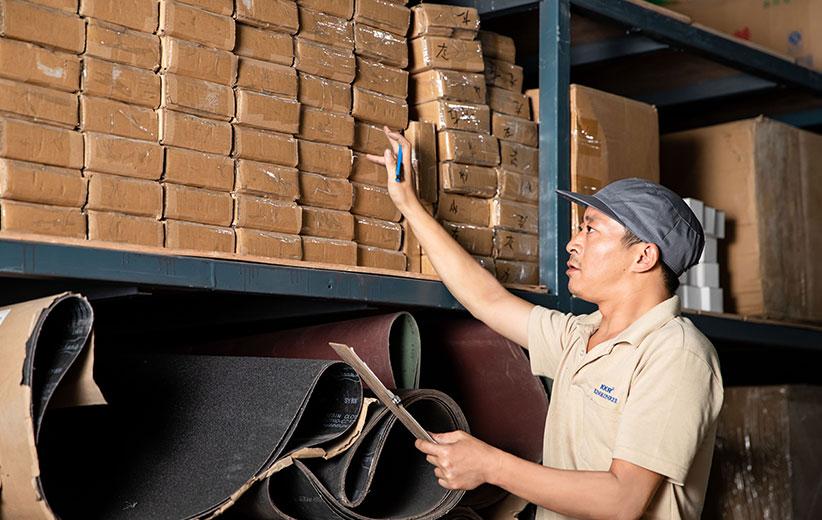
Solid surface sheets and fabricated countertops require suitable packaging to prevent damage during transportation.
Confirm protective materials, crate construction, labeling, loading arrangements, and responsibility for freight-related damage.
For international orders, clarify shipping terms, customs documentation, and final delivery arrangements before payment.
Conclusion
A solid surface countertop is an engineered worktop made from acrylic or polyester resins, mineral fillers, and pigments. Its non-porous structure, customizable appearance, and repairable surface make it suitable for a wide range of residential and commercial applications.
Understanding what a solid surface countertop is and how it compares with quartz, granite, and laminate helps buyers choose the most appropriate material.
Solid surface performs particularly well when design flexibility, coordinated colors, integrated sinks, and inconspicuous joints are important. However, protection against scratches and excessive heat is necessary.
KKR Stone manufactures solid surface sheets and countertops for residential, commercial, and customized projects. Buyers can explore the available solid surface countertop range or contact KKR Stone for technical specifications and quotations.
FAQs
Is solid surface a good countertop material?
Yes. Solid surface is a good countertop material for kitchens, bathrooms, and commercial interiors where non-porous construction, easy cleaning, repairability, and customized designs are important. However, it requires protection from hot cookware and sharp objects.
Are solid surface countertops worth it?
Solid surface countertops can be worth the investment when long-term repairability, integrated features, and coordinated designs matter. Their value depends on material quality, fabrication costs, installation, and how the countertop will be used.
What are Corian solid surface countertops?
Corian countertops are a branded type of acrylic solid surface material. They contain acrylic resin and mineral fillers and are known for non-porous construction, fabrication flexibility, and repairable finishes. Corian is a brand, not a general name for every solid surface product.
Is a solid surface countertop the same as quartz?
No. Solid surface generally contains acrylic or polyester resin with mineral fillers, while engineered quartz uses a different composition of mineral aggregates and resin. Quartz is usually harder, while solid surface offers advantages for certain custom shapes and surface repairs.